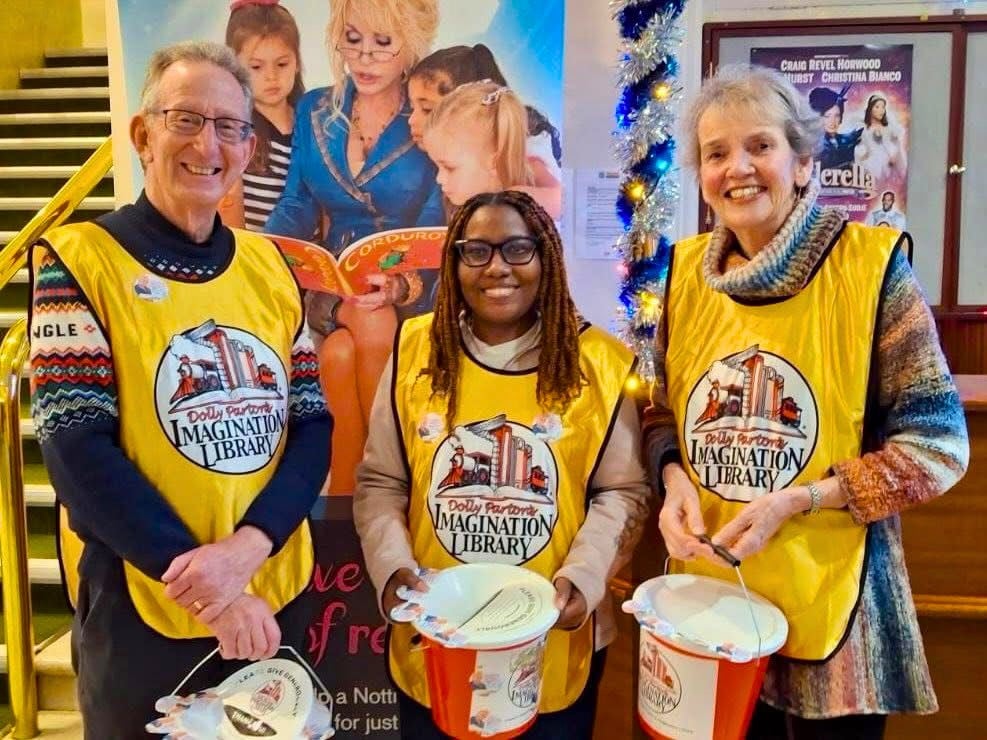
For the Rotary Club of Nottingham, Dolly Parton’s Imagination Library stopped from simply being another project a long time ago.
Fourteen years after the club helped launch the programme across some of the city’s most disadvantaged communities, it has become part of Nottingham Rotary’s identity.
More than 600,000 books have been distributed, 1,900 children are currently registered, and thousands of families have been reached with more than 13,000 children registered since the start of the scheme. But there has been another consequence.
“It feels like it’s one of those things that’s synonymous with what we do,” says Sophie Leadley, the club’s Head of Public Image.
“I genuinely think that step of setting it up in 2012, and particularly Leni’s (Gelblum) passion for the project, almost set the direction for our club.
“In Nottingham, there is also evidence of what that commitment has achieved.”
“A lot of what we do is around women’s and children’s charities in the city. We do a lot of stuff for schools. So, in a way, it set the direction for what our club is today.”
The roots of the East Midlands project go back to 2009 when Cheryl Mitchell, a teaching assistant at Fernwood Infant School in Wollaton, Nottingham, introduced the Imagination Library on a small scale.
Three years later, members of the Rotary Club of Nottingham saw the potential to take it much further.
Leni Gelblum and Peter Moore were instrumental in driving the idea forward, working with Nottingham City Council to expand the programme initially into Bilborough and subsequently into communities including Hyson Green, Radford and Dunkirk.
What followed was a network of partnerships involving the council, health visitors, children’s centres, community organisations, the National Lottery Community Fund and Small Steps Big Changes.
Rotary helped provide the connections between them – and, crucially, stayed involved.
Leni died several years ago, but Peter, a Nottingham Rotarian for more than 50 years, remains a trustee.
The project has since grown sufficiently large to become the Nottingham Imagination Library, a registered charity in its own right, with one trustee from Nottingham Rotary in Peter Moore, two from Nottingham City Council and a fourth independent trustee.
For Rotary, that has meant a commitment stretching far beyond fundraising. Members have helped with governance, promotion and collections, worked with community partners and supported the continuing search for funding.
And over 14 years, the way the project has been financed has repeatedly had to adapt. Initially, Rotary and Nottingham City Council broadly shared the cost. Later, substantial grants from the National Lottery and Small Steps Big Changes provided financial security for several years.
More recently, funding has become more piecemeal. There was a significant boost in May when Nottingham City Council announced another £150,000 per year investment over the next two years, with the possibility of two years extended funding beyond that day.
Public Health have also awarded a one-off grant of £250,000 which will enable Nottingham Imagination Library to register children at birth from many of the deprived areas of the city.
For Sophie, the club’s contribution should not simply be measured by how much money its members put into the pot. “We’re not a massive fundraising club,” she explains. “We tend to give our time more than we do money. That’s our club’s ethos.”
In Nottingham, there is also evidence of what that commitment has achieved. A Nottingham Trent University evaluation examined the reading behaviour of families involved with the Imagination Library and compared them with families who were not participating.
“When I go to talk to them about it, they’re all interested.”
It found that parents whose children had received books for more than a year were more likely to read with them every day. Children who had participated for two years or more had longer reading sessions and more frequent interaction with their parents.
For Sophie, herself the mother of a young daughter, those findings help explain why the club has remained committed for so long.
“It’s not just providing a book; it’s providing an opportunity for that parent to engage with that child,” she says. “That bedtime story; you talk to anybody and that’s their enduring memory of reading to their children. It helps set that discipline around reading and literacy. It’s so much more than a book.”
52,000 books on the Lincolnshire coast
Some 75 miles north-east from Nottingham on the Lincolnshire coast, the Rotary Club of Cleethorpes has been building its own Imagination Library story.
Its involvement dates from 2014 when Rotarian and Dolly Parton enthusiast Rolf Sperr became the driving force behind developing the programme locally.
Rolf spent years pursuing grants and other sources of funding to keep the project running. By July 2026, Cleethorpes Rotary had distributed more than 52,000 free books to registered children, with 22 schools across North East Lincolnshire now cooperating with the programme.
Today, the club’s Imagination Library lead is Sandy Holmes, whose background is in education.
For Nisha Driver, who joined Rotary four years ago and is the club’s incoming president, the challenge is to build on what Rolf began and secure the programme’s future. “This is my passion,” she says. “I’ve taken on this project because I’m passionate about it.
“It’s such a good project for Rotary clubs and for the other corporates. When I go to talk to them about it, they’re all interested.”
Unlike Nottingham, Cleethorpes does not have one large funding partnership underpinning the scheme. Most of its books are paid for by Rotary through grants and other fundraising, although some schools also fund their own participation.
Nisha estimates that Rotary is currently spending around £5,500 a year on the programme. “We have to carry on fundraising and getting more and more grants,” she admits.
The club is now reopening conversations with the local authority while also looking towards businesses and corporate members as potential partners.
Nisha points to neighbouring North Lincolnshire, where the local authority funds the Imagination Library, and says improvements in the proportion of children achieving a good level of development after the programme was introduced demonstrate why she wants to secure its future in North East Lincolnshire.
“I am just as committed as Rolf is to this programme,” she says. “As the incoming president of Cleethorpes Rotary, I will continue this work, especially to ensure there is funding for this vital project.”
There is another dimension to what is happening in Cleethorpes. Like many Rotary clubs, its membership was affected by the pandemic and the departure of some long-standing members. But the picture is changing.
Five new members have joined during the past six months and there are prospective corporate members waiting to come on board.
At the same time, responsibility for the Imagination Library is moving to a new three-person team, including Rotarians with backgrounds in education.
A project which began under Rolf Sperr more than a decade ago is being handed to another generation.
New members, new chapter
The same issue of succession is being discussed in Nottingham. There, some of the Rotarians who have carried the Imagination Library for years belong to the club’s older generation.
Meanwhile, Nottingham Rotary itself has been changing. Last year it welcomed 12 new members, many in their 30s, 40s and 50s.
The Imagination Library was already so deeply established that newer members could know about it without necessarily having much involvement beyond helping at an occasional collection.
Sophie believes Dolly Parton’s death has changed that conversation. “I think Dolly Parton’s passing is a real opportunity for us to reflect on how successful it’s been, how brilliant it is and, actually, what do we need to do to make sure that legacy continues?” she says.
“I think it is going to be a fantastic way of galvanising some of those newer and younger members into getting more involved, rather than just standing and holding a collection bucket every so often.
“It becomes much more about being structurally involved and thinking about it as a project that we need to take forward.
“I think the appetite for making sure we keep that legacy going will be much, much higher now.”
Later on in September, Sophie and two members of Nottingham Rotary Club will be taking part in the Robin Hood Half Marathon to raise money for the Imagination Library, with Past President, Paul Jones, planning to run dressed as Dolly. Now that leaves a lot to the imagination!
READ MORE
Nottingham Trent University’s evaluation of Dolly Parton’s Imagination Library in Nottingham examined its impact on the reading behaviour of parents and young children.